

FUTURE-MAKERS
How do we imagine, test and make a future worth living in?
From future thinking to visions of society, cities, architecture and mobility through OasisConcept practice

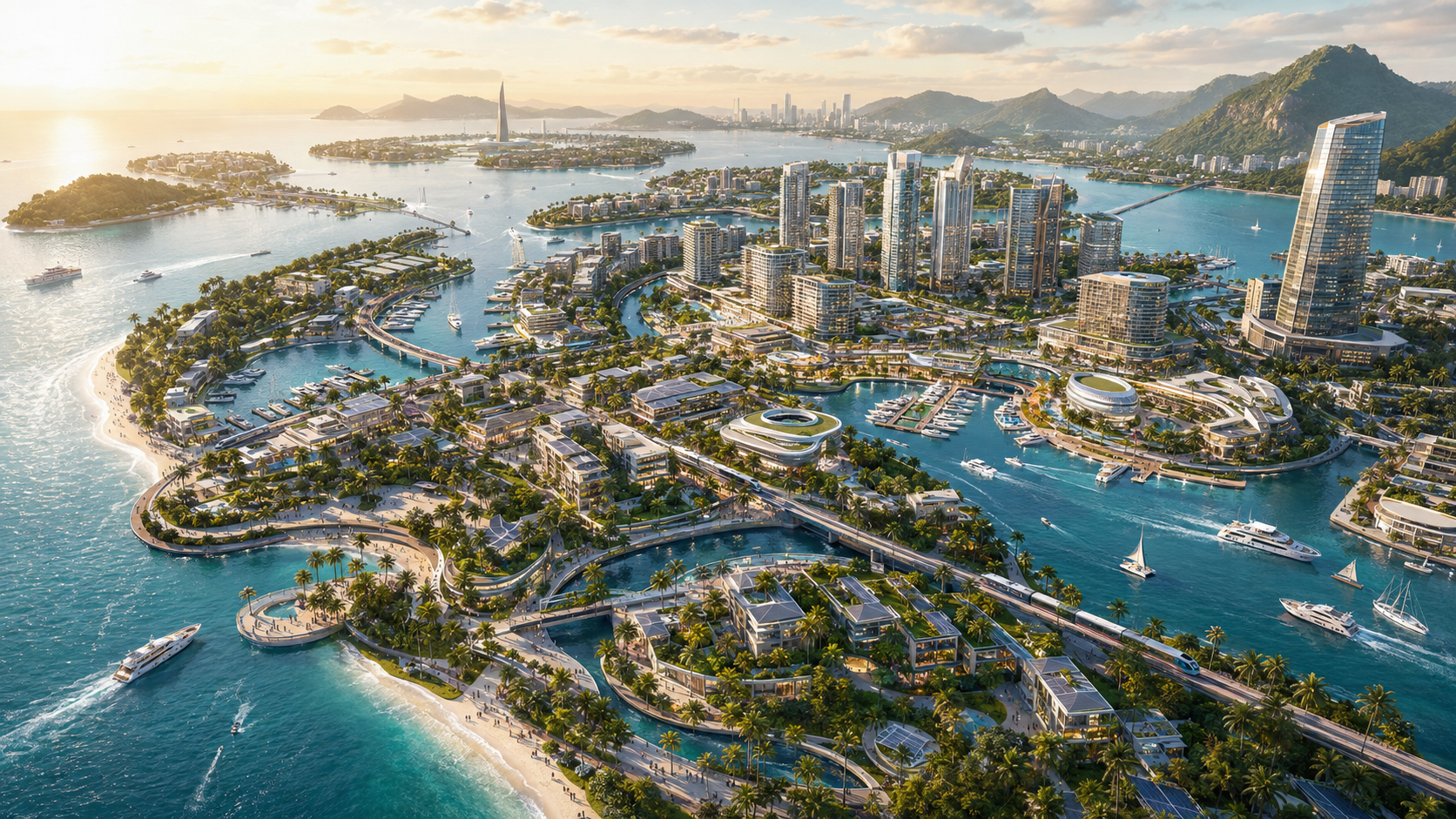
Cover image. A composite vision of future metropolitan landscapes: a polycentric waterfront city, clean mobility, tropical public realm and blue-green structure. Editorial visioning developed from OasisConcept spatial language; exploratory scenario, not a prediction.
|
SIGNATURE PROPOSITION |
Architecture · Urbanism · Landscape · Strategy | Designing future metropolitan landscapes for Southeast Asia
WEBSITE EDITORIAL MASTER
HOW TO READ THIS FLAGSHIP INSIGHT
This article asks two questions in parallel: how should we think about the future, and what might that future look, operate and feel like through OasisConcept practice? Rather than treating the future as a fixed image, the article uses futures literacy, scenario thinking, design philosophy and project proof-points to develop a continuous argument: a future worth living in must be imagined, tested, adapted and progressively made.

Diagram 1. Future Cone 2026-2126: distinguishing probable, plausible, preferable and reframed futures. Source/Credit: OasisConcept editorial diagram, 2026; concept informed by futures studies [R01]-[R02].
|
AN IMPORTANT GUARDRAIL |
01 · FUTURES LITERACY
THE FUTURE IS NOT A PREDICTION
1.1. A future-oriented profession that learns mainly from the past
Planning contains a particular paradox. We design for communities that do not yet exist, mobility systems that have not yet operated, and climatic and technological conditions that differ from today. Yet professional knowledge is built largely from precedent, historical data, regulations and delivery experience. Experience is the foundation of judgement; at the same time, it always carries a time lag.
|
“As an architect you design for the present, with an awareness of the past, for a future which is essentially unknown.” — Norman Foster [R08] |
1.2. Futures Literacy: imagination as a learnable capability
UNESCO describes Futures Literacy as a capability that helps people recognize how images of the future shape decisions in the present. The future does not yet exist; what can be trained is the quality of how we “use the future”: the assumptions built into scenarios, the groups of people included, the risks overlooked, and the possibilities we allow to emerge. [R01]-[R02]
This moves imagination beyond the realm of artistic inspiration and into professional reasoning. Disciplined imagination does not replace evidence; it allows evidence to answer larger questions.
|
FORECAST |
SCENARIO |
VISION |
DESIGN |
In this view, being future-ready does not mean adopting the greatest amount of technology. It means being able to create multiple credible options, recognize uncertainty, and translate a desirable future into spatial decisions that can be tested.
02 · INTELLECTUAL GENEALOGY
A SHORT GENEALOGY OF IMAGINED CITIES
The history of modern urbanism contains many visions that never became reality in a literal sense. Yet they remain influential because each reframed a foundational assumption about the city. This section stays deliberately concise: not a catalogue of forms, but a reading of each idea as a question generator for contemporary practice.
|
Idea / thinker |
Question opened |
Lesson for future practice |
|
1960s · Archigram / Plug-In City |
Change & obsolescence |
If components have different lifecycles, why should a master plan fix all of them in the same way? [R15] |
|
1970s · Cedric Price |
Technology & purpose |
Technology becomes meaningful only after the social-spatial question has been defined. [R12] |
|
Arcology · Paolo Soleri |
Density & sprawl |
Sometimes the problem must be restructured at the scale of the development model, rather than solved by optimizing individual infrastructures. [R16] |
|
Systems · Buckminster Fuller / Alan Kay |
Agency & invention |
The future does not simply “arrive”; design and collective choices help create its trajectory. [R13]-[R14] |
|
1990s · Stewart Brand |
Adaptability |
Every building contains an implicit forecast; the capacity to change is therefore a quality criterion. [R21] |
|
2000s+ · Jan Gehl / Kongjian Yu / Carlo Ratti |
Human scale · water · feedback |
Life before form; water as infrastructure; technology as a learning loop, not a spectacle. [R17]-[R19] |
|
“Technology is the answer, but what was the question?” — Cedric Price [R12] |
|
“The best way to predict the future is to invent it.” — Alan Kay [R14] |
What influential visions share is not a futuristic appearance, but the capacity to reveal assumptions that have become invisible through familiarity. This is also the logic OasisConcept seeks to retain: precedent is a question, not an answer.
03 · HUMAN FLOURISHING
WHAT KIND OF SOCIETY ARE WE DESIGNING FOR?
A future city may have AI, sensors, autonomous mobility and digital twins and still fail to be worth living in. A higher standard is human flourishing: does the city help people live healthier lives, learn better, form deeper social connections, access opportunity more fairly, and live closer to nature?

Figure 2. Future urban society: waterfront public realm, walkability, cycling, clean shuttles, water taxis, mixed-use ground floors and everyday social life. Editorial visioning developed from the OasisConcept design ethos; exploratory scenario, not a prediction.
3.1. A society of lifelong learning, flexible work and more “third places”
As knowledge and technology change rapidly, learning no longer ends at school. Campuses, innovation commons, libraries, maker spaces, café streets, civic halls and public realm become part of a learning infrastructure. Thuong Cat TIC frames “Live - Work - Learn - Innovate - Thrive” as an ecosystem logic, showing how urban programmes can organize these activities as an interactive loop rather than as isolated functional zones. [R33]
3.2. Care, belonging and trust as urban infrastructure
An older, more diverse and more digital society will need places that create a stronger sense of belonging. Technology can optimize operations, but social trust, climate comfort, public realm, culture and embodied experience cannot be fully digitized. The city of the future therefore needs “care infrastructure”: healthcare, wellness, community space, universal access, shade, greenery, clean air, and places of encounter that are not entirely commercialized.
|
“First life, then spaces, then buildings.” — Jan Gehl [R17] |
04 · A VALUE HIERARCHY
FIVE PRINCIPLES FOR THE FUTURE CITY
|
01 · LIFE BEFORE FORM |
Begin with life, behaviour, needs and interaction; form is the result of how systems serve people. |
|
02 · ACCESS BEFORE SPEED |
Optimize accessibility rather than speed alone. Proximity, transit, walking, cycling and water mobility should connect as a time-based network. |
|
03 · REGENERATION BEFORE EXTRACTION |
Landscape, water and ecology are productive infrastructure: cooling, retaining water, creating habitat, protecting shorelines, generating energy and improving quality of life. |
|
04 · SYSTEMS BEFORE OBJECTS |
A density decision affects mobility, water, infrastructure cost, social mix and public-transport viability. Future urbanism must see relationships before objects. |
|
05 · ADAPTABILITY BEFORE FIXED PERFECTION |
Good design does not lock the future into a single build-out image. It defines stable cores, adaptive layers and triggers for change as conditions evolve. |

Diagram 3. Adaptive 15-Minute City: Blue-Green Network + Daily-Life Network -> Proximity + Resilience + Livability. Source/Credit: OasisConcept editorial synthesis from the VGU reflection, 2026 [R29].
|
OASISCONCEPT THESIS |
05 · PRACTICE AS A TEST BED
THREE OASISCONCEPT SEEDS OF THE FUTURE
The projects below are not labelled “future cities.” They are read as test beds where certain logics may evolve into future practice. This distinction matters: it separates image-led promotion from the construction of an intellectual proposition.
5.1. Thuong Cat TIC - from technology park to innovation metropolis
Thuong Cat TIC does more than place technology inside a real-estate development. The study defines TIC as strategic infrastructure connecting an urban sandbox, R&D, talent, capital, data infrastructure and public realm, while organizing the spatial framework around “4 Cores - 5 Spines - 1 Living Lab Loop.” [R33] It is a seed for a future society in which learning, working, testing, investing and everyday urban life take place within one ecosystem.
|
Figure 4. TIC as an Integrated Innovation Metropolis. |
Figure 5. 4 Cores - 5 Spines - 1 Living Lab Loop. Source: Thuong Cat TIC Concept [R33]. |


Figure 6. Visioning: a canal-side innovation metropolis with a transit corridor, research campuses, public realm and blue-green infrastructure. Developed from the TIC logic; exploratory scenario, not a prediction.
5.2. MBLand Island - from artificial island to a coastal-adaptive archipelago
MBLand Island establishes an important principle: island form should not begin with an architectural gesture, but should be guided by bathymetry, hydrodynamics, design-to-cost, phasing and product strategy. [R34] “Island identity” therefore becomes the outcome of local intelligence and long-term development logic rather than an iconic shape detached from the sea.
|
Figure 7. MBLand Island - a vision for eco-luxury living, wellness and experience. |
Figure 8. Mobility structure and marina connections. Source: MBLand Island Concept [R34]. |


At a longer horizon, this principle expands into archipelago urbanism: multiple islands or districts can operate independently, expand by phase, connect through water mobility, and retain an ecological/public-realm framework as a stable core.
5.3. 561-KDV - compact urban living and “everyday adaptability”
561-KDV brings future thinking back to a very immediate challenge: limited land, high density, mixed-income housing, transit access and the demand for a higher quality of everyday life. The master plan organizes residential blocks around shared open space, while the apartment and podium strategies demonstrate how residential, service, amenity and technical layers can be separated. [R35] Future urbanism does not exist only at megaregional scale; it also lies in making the city block work better every day.
|
Figure 9. 561-KDV - roof master plan, residential-block organization and shared open space. |
Figure 10. 561-KDV - overall perspective as a proof point for compact mixed-use urban living. Source: 561-KDV Concept [R35]. |


06 · EXPLORATORY SCENARIOS
THREE EXPLORATORY HORIZONS: 2055 · 2075 · 2125
The three horizons below are design stress tests, not probabilistic forecasts. They place practice within conditions sufficiently different from today to reveal which assumptions need to be redesigned. Each horizon carries two layers of naming: an intellectual proposition and a more accessible description for a public audience.

Diagram 11. Three horizons of 30, 50 and 100 years. Source/Credit: OasisConcept editorial synthesis, 2026; exploratory scenarios, not predictions.
2055 · THE AI-AUGMENTED, HEAT-ADAPTIVE PROXIMITY CITY
A close, cool and intelligent city. This horizon sits squarely within the lifecycle of many master plans initiated today. AI becomes a copilot for scenario generation, demand modelling, mobility and climate analysis, but accountability and public values remain matters of human judgement. Heat adaptation shifts from landscape enhancement to public-health infrastructure. Mobility shifts from maximizing speed to maximizing accessibility. [R01]-[R07]
06 · HORIZON +50 YEARS
2075 · ADAPTIVE POLYCENTRIC CITY-REGIONS
Polycentric city-regions in a demographically divergent world. By this stage, some regions may still be growing rapidly while others are ageing or shrinking. “Growth planning” can no longer be the only language of planning. Neighbourhood proximity must connect with regional accessibility, employment clusters, logistics and ecological networks. Governance must follow functional geography - water basins, mobility corridors, labour markets and ecological systems - rather than administrative boundaries alone.
The master plan becomes an adaptive framework: stable cores, modular districts, flexible parcels and phasing triggers. Building stock is treated as a long-life platform and a material bank. This is a horizon in which transform-first thinking and circularity may become more normal in carbon-constrained development. [R05], [R11], [R21]

Figure 13. Horizon 2075/2076: a polycentric resilient megaregion - connected, regenerative and inclusive. AI-generated editorial visualization for OasisConcept; exploratory scenario, not a prediction.
|
REGIONAL TEST |
06 · HORIZON +100 YEARS
2125 · BIOREGIONAL · COASTAL-ADAPTIVE · TRANSLOCAL URBANISM
A regenerative coastal urban civilization. A century is too long to predict specific technologies, but short enough for today’s infrastructure and shoreline decisions to continue creating path dependency. The IPCC indicates that sea-level rise continues beyond 2100; coastal planning therefore needs a “time architecture,” not only a spatial architecture. [R07]
The coastline is treated as a dynamic zone: retreat, protect, accommodate and ecological-buffer strategies can change according to triggers. Kongjian Yu’s “Sponge Planet” expands water-cycle logic from plot to watershed, from city to bioregion. Urbanism becomes increasingly translocal: people, capital, knowledge, production and culture operate across multiple places, while the value of place increasingly lies in climate comfort, social trust, ecology, culture and embodied experience. [R18]

Figure 14. Horizon 2125/2126: a regenerative ocean-edge civilization - adaptive coastline, ecological restoration, clean energy and amphibious/floating urbanism. AI-generated editorial visualization for OasisConcept; exploratory scenario, not a prediction.
|
100-YEAR TEST |
07 · PROFESSIONAL PHILOSOPHY
FROM EXPERT TO FUTURE-MAKER
Future expertise does not reject experience. It changes how experience is used. Today’s expert has an advantage because they know what has worked; a future-maker needs additional capacities to observe change, interpret systems, generate alternatives, integrate multiple disciplines, and turn possibility into a proposition that can be tested and delivered.

Diagram 15. Future Planner Capability Map: deep expertise complemented by systems thinking, futures literacy, AI/data literacy, climate intelligence, translation/collaboration and adaptability. Source/Credit: OasisConcept editorial synthesis, informed by [R01]-[R07].
|
EXPERT |
OBSERVER |
INTERPRETER |
IMAGINEER |
INTEGRATOR |
FUTURE-MAKER |
|
“Sangath is an ongoing school where one learns, unlearns and relearns.” — Balkrishna Doshi [R09] |
At the organizational level, this suggests a practice in which research <-> project, senior experience <-> young designers, academia <-> practice, simulation <-> built reality, and post-occupancy learning <-> new briefs operate as feedback loops rather than separate silos.
08 · OPERATING METHOD
DISCIPLINED IMAGINATION
Precedent is valuable not because it can be copied, but because it helps us ask a better question. Imagination becomes a professional capability only when it is translated through local intelligence and evidence. This is the “how” layer of future practice.

Diagram 16. Disciplined Imagination: Precedent -> Question -> Principle -> Local Intelligence -> Hypothesis -> Test -> Place. Source/Credit: OasisConcept editorial methodology, 2026.
|
“We never see the existing as a problem.” — Anne Lacaton [R11] |
|
“I am hoping to change the paradigm, push people to dream and undergo risk.” — Francis Kéré [R10] |
8.1. Evidence does not kill creativity
A green rendering does not prove thermal comfort. A courtyard does not prove community. An opening does not prove ventilation. A flexible unit does not prove adaptability. Future-oriented design must therefore translate propositions into hypotheses that can be tested through simulation, scenarios, prototypes, cost logic, phasing or post-occupancy learning.
This creates a loop: drawing -> hypothesis -> test -> revision -> delivery -> observation -> new knowledge. Creativity is not narrowed; on the contrary, a team can advance bolder hypotheses because they know those hypotheses will be tested before becoming claims.
|
METHOD THESIS |
09 · EMERGING METHODOLOGY
VIA - VISION · IMAGINATION · ADAPTABILITY
VIA is not proposed as a style or slogan replacing the current method. It is an additional capability layer for integrated design: seeing beyond the brief, opening up more alternatives, and designing so that core values can remain alive as conditions change.

Diagram 17. VIA Framework: Vision - Imagination - Adaptability with Local Intelligence at the centre. Source/Credit: OasisConcept editorial methodology proposal, 2026.
V · VISION - What future is worth creating?
Vision is a direction of value, not a hero rendering. A strong vision connects change drivers with the kind of life, accessibility, ecological performance and long-term identity the project seeks to create.
I · IMAGINATION - What could be possible?
Imagination expands the option space before convergence. “What if?” must generate alternatives concrete enough to debate, simulate and evaluate, rather than merely produce different images.
A · ADAPTABILITY - What if conditions change?
Adaptability does not mean making a generic design. The better question is: what needs to remain stable so that other things can change safely? At master-plan scale, ecological/public-realm frameworks and primary movement systems can be long-life layers, while parcels, programmes, uses and technologies change more quickly.
|
Diagram 18. Stable Core - Adaptive Layers. |
Diagram 19. Understand -> Envision -> Imagine -> Shape -> Test -> Deliver -> Adapt. |


10 · SIGNATURE PROPOSITION
MANIFESTO · DESIGNING CAPACITY FOR CHANGE
The twenty-first century gives us unprecedented amounts of data, simulation capacity and computational tools, while also forcing the profession to work with greater uncertainty around climate, demographics, technology, geopolitics and social expectations. The more forecasting capacity we acquire, the more humility we need about the limits of forecasting.
Future expertise therefore does not lie in remembering more about what has happened, but in combining experience with vision; evidence with imagination; form with systems thinking; and design intent with adaptability. For OasisConcept, future practice should be treated as a learning programme through projects: each project becomes a test bed for Vision, Imagination, Evidence, Adaptability and Local Intelligence.
OASISCONCEPT · FUTURE PRACTICE PROOF-POINT MATRIX
|
Project / study |
Vision |
Imagination |
Adaptability |
Evidence |
|
Thuong Cat TIC |
Knowledge & innovation metropolis |
4 cores · 5 spines · living lab |
TOD, digital + public realm systems |
Concept study [R33] |
|
MBLand Island |
Eco-luxury coastal/archipelago urbanism |
Bathymetry + hydrodynamics + identity |
Phased & scalable island structure |
Concept study [R34] |
|
561-KDV |
Compact mixed-income urban living |
Podium + open space + vertical community |
Layered program & dense urban block |
Concept study [R35] |
|
Hiep Hoa 185 ha |
Green-led township |
Green Spine + Community Hearts |
Phasing, service radius, network logic |
Internal study [R30] |
|
Adaptive 15-Minute City |
Proximity + resilience + livability |
Blue-green + daily-life networks |
Principles vary by scale/context |
VGU reflection [R29] |
|
FUTURE-MAKERS |
Signature proposition: “How do we imagine, test and make a future worth living in?” This is the central question linking futures literacy with design practice: seeing beyond what is already known, opening new possibilities, testing them through evidence and local intelligence, and designing with enough flexibility to remain valuable as conditions change.


