

FROM MEGACITY SCALE TO METROPOLITAN PERFORMANCE
Why spatial structure, accessibility and governance—not size alone—will determine the economic performance of the Ho Chi Minh City mega-urban region.

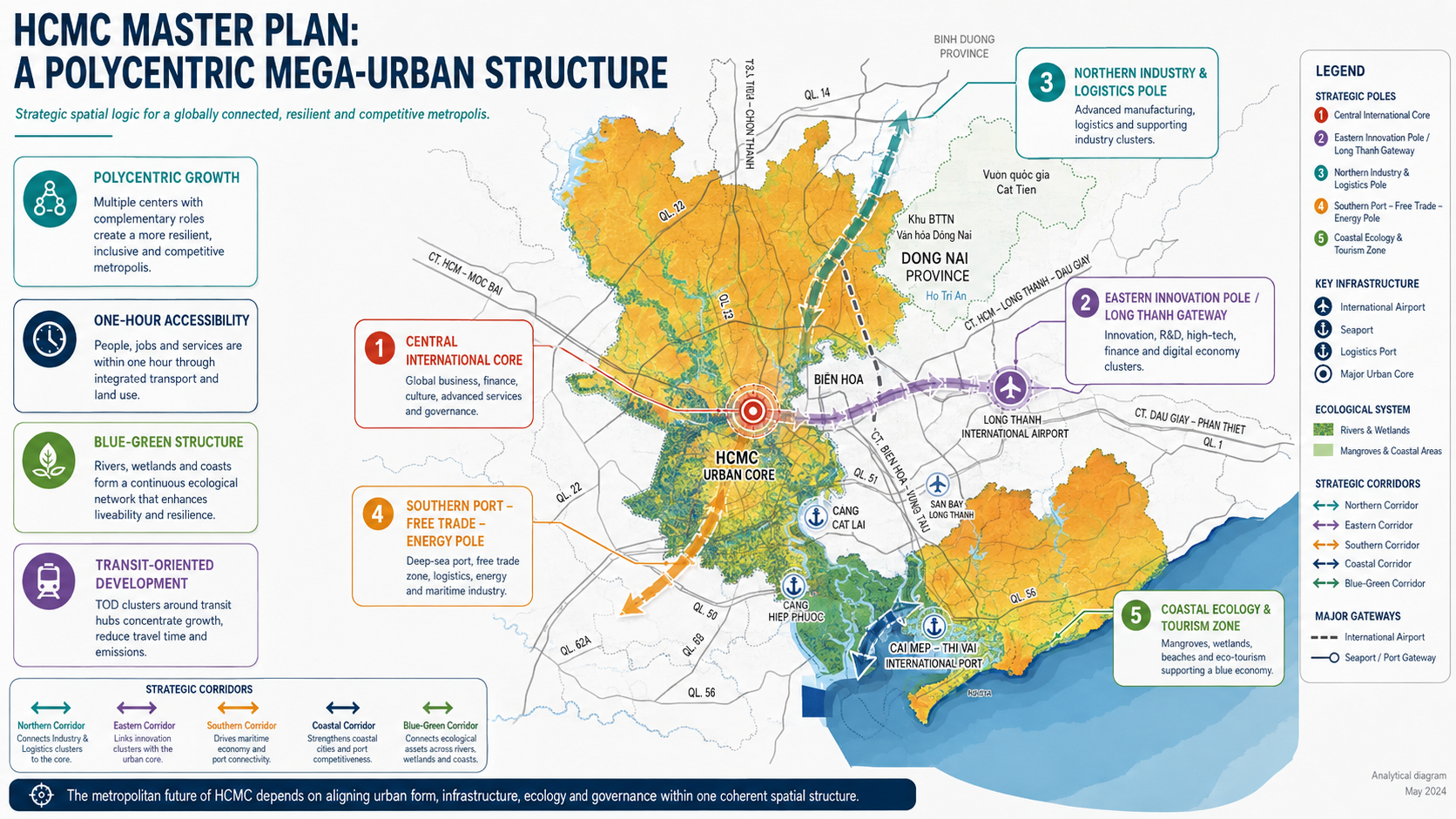
Figure 1. HCMC as a polycentric mega-urban system. OasisConcept analytical redraw on the HCMC Total Master Planning base map supplied by the client. The overlay identifies strategic poles, gateways, ecological systems and corridors for analytical communication; it is not a statutory land-use or zoning map.
Abstract
The administrative consolidation of Ho Chi Minh City, Bình Dương and Bà Rịa–Vũng Tàu creates an urban territory of approximately 6,772.6 km² and 14.4 million residents in the July 2026 master-planning working draft. The central planning question, however, is not whether the new city is large enough to qualify as a megacity, but whether its spatial structure can convert scale into productivity, accessibility and long-term resilience. Drawing on the HCMC planning materials, the UAH–HIDS conference proceedings and international empirical research on agglomeration, polycentricity, transport accessibility and metropolitan governance, this article argues for a conditional—not ideological—form of polycentricity: protect the agglomeration advantages of the core, build genuinely specialized secondary poles, reduce generalized travel time between complementary functions, and align metropolitan governance with the functional geography of labour, logistics, ecology and knowledge flows.
1. Scale is an input; productivity is an outcome
Urban economics gives a precise reason why spatial structure matters. Alfred Marshall’s image that the “mysteries of the trade… are as it were in the air” describes what later literature formalized as agglomeration economies: firms and workers become more productive when proximity improves access to suppliers, specialized labour and knowledge. Duranton and Puga (2004) reorganized these mechanisms as sharing, matching and learning. The point is not density for its own sake; it is the economic interaction that density and accessibility make possible.
The empirical literature broadly supports a positive agglomeration effect, but also warns against universal numbers. Melo, Graham and Noland’s (2009) meta-analysis reviewed 729 elasticity estimates from 34 studies and found generally positive productivity effects, but substantial variation across countries, sectors and model specifications. Ahrend et al. (2017), using harmonized functional urban areas across five OECD countries, similarly found that doubling city size is associated with roughly a 2–5% productivity premium, after accounting for worker sorting. These results justify seeking agglomeration benefits, but not confusing administrative size with effective economic mass.
For HCMC, that distinction is decisive. The working draft itself identifies a three-level bottleneck: visible problems such as congestion and flooding; structural problems such as weak connectivity; and a deeper spatial problem in which urban form and infrastructure have not yet been organized as one coherent system. The practical implication is that the new territory should not simply be filled with development. It should be organized to increase effective density—the amount of economic opportunity reachable within acceptable time and cost—while avoiding the congestion, flooding and infrastructure diseconomies that can erase the gains from agglomeration.

Figure 2. The scale–performance paradox. Indicative economic-density comparison reported in the 2026 conference research and redrawn by OasisConcept. The comparison is used as a diagnostic, not as a claim that economic density alone defines urban success.
2. Polycentricity is a condition to be tested, not a doctrine to be applied
The strongest reason to avoid a simplistic “more centres are better” narrative is that the empirical evidence is mixed. Zhang, Sun and Li (2017) found higher labour productivity associated with polycentric urban structure in Chinese city-proper data. Yet Li, Sun and Zhang (2019), studying prefectural regions, found the opposite: more monocentric structures performed better. Li and Liu (2018) reconciled part of this tension by showing that the effect depends on density—polycentricity was associated with higher productivity in denser cities, while lower-density cities tended to benefit from monocentricity. Wang, Derudder and Liu (2019) added a multiscalar result: intra-urban monocentricity and inter-urban polycentricity can coexist with higher productivity.
This is not a technical footnote; it changes the planning prescription. Polycentricity should be understood as an organizational strategy for a region that has already reached a scale at which one core cannot efficiently carry every function. It succeeds only when secondary centres are sufficiently dense, functionally differentiated and strongly connected. Hall and Pain (2006) describe the possibility of “borrowed size,” while Meijers and Burger (2010) examine whether nearby linked centres can share agglomeration advantages. Later work shows that the strength of integration between centres matters at least as much as the number of centres themselves (Meijers, Hoogerbrugge & Cardoso, 2018).
The July 2026 HCMC master-planning working draft is therefore most convincing when its five growth poles are read as complementary economic specializations: an international central core; an eastern innovation pole; a northern industrial–logistics pole; a southern port–free-trade–energy pole; and a marine-tourism pole. The policy test is not whether all five appear clearly on a diagram, but whether each develops a distinct labour market, knowledge base, supplier network and infrastructure relationship to the others.

Figure 3. From multiple centres on a map to functional polycentricity. OasisConcept analytical diagram based on the polycentricity literature and the HCMC conference research. A visually polycentric system is not necessarily economically integrated.
3. Accessibility is the bridge between urban form and productivity
The OECD–EU concept of the Functional Urban Area (FUA) is useful because it defines a city through an urban core and its commuting zone rather than by administrative borders. In other words, the economic city is the territory people can actually use. For HCMC, this makes Long Thành, Đồng Nai’s industrial system and the western gateway toward Tây Ninh functionally relevant even when they lie outside the administrative boundary of the consolidated city.
Transport research makes the productivity mechanism more concrete. Graham (2007) shows that transport investment can raise productivity when it increases firms’ access to economic mass. Melo et al. (2017), using employment accessibility in large US metropolitan areas, estimate agglomeration elasticities of roughly 0.07–0.10 and find that most of the measured productivity effect occurs within the first 20 minutes of access. The exact elasticities should not be transplanted mechanically to Vietnam, but the structural lesson is highly relevant: metropolitan integration is better measured by time-to-opportunity than by kilometres of infrastructure built.
This provides a stronger scientific basis for reading the HCMC planning concepts of a 15-minute neighbourhood, a 30-minute polycentric city and a wider one-hour economic region. These should not be treated as marketing promises or universal isochrones. They are performance targets at different scales: daily services at neighbourhood scale; cross-pole labour and knowledge exchange at metropolitan scale; and airport–port–industry–innovation flows at regional scale. The design objective is to reduce generalized travel time while increasing the number and diversity of opportunities reachable within each time band.

Figure 4. Nested accessibility: 15 / 30 / 60 minutes. OasisConcept synthesis of neighbourhood, metropolitan and regional accessibility concepts. The rings are performance concepts rather than literal statutory catchments.
4. Specialization matters because agglomeration is not generic
Michael Porter (1998) defines clusters as geographic concentrations of interconnected firms and institutions in a particular field. That definition is important for HCMC because it shifts the discussion from land-use labels to economic ecosystems. An “innovation pole” is not created by zoning land for technology; it requires universities, R&D facilities, venture capital, skilled labour, advanced services, housing and global connectivity. A “logistics pole” is not created by warehouses alone; it requires ports, rail, road, customs, digital freight systems, suppliers and industrial demand.
Accordingly, OasisConcept proposes that each strategic pole be tested through six conditions: (1) a primary economic specialization; (2) anchor institutions; (3) a matching labour and housing market; (4) high-capacity physical and digital connectivity; (5) a supplier and knowledge ecosystem; and (6) a clear complementary relationship with other poles. If these conditions are absent, polycentricity risks becoming dispersed real estate rather than metropolitan economic structure.

Figure 5. Integrated polycentric economic region: analytical synthesis. OasisConcept diagram combining the HCMC master-plan pole logic with a wider functional-region interpretation that includes Long Thành and external gateways.
5. Blue–green structure is part of the productivity system
The economic literature on agglomeration is often read too narrowly, as if productivity were produced only by firms, transport and density. In a flood-prone tropical metropolitan region, ecological performance is also an economic variable because recurrent flooding, heat stress, water insecurity and ecosystem loss affect infrastructure reliability, health, land values and investment risk. The HCMC master-planning materials explicitly identify the Sài Gòn–Đồng Nai–Thị Vải–Soài Rạp water system, Hồ Dầu Tiếng and the Cần Giờ mangrove system as a metropolitan ecological structure.
For planning practice, this implies a sequencing principle: hydrology and ecological capacity should be established before development intensity is assigned. The blue–green network should therefore be treated as infrastructure that stores water, reduces heat, maintains biodiversity, supports public space and protects the economic continuity of the urban system. In this sense, resilience is not a separate environmental chapter; it is a condition of metropolitan productivity.

Figure 6. Blue–green strategic structure in the HCMC master plan. Source base: HCMC Total Master Planning working draft, July 2026; clean analytical presentation by OasisConcept. The map shows the principal river, wetland, mangrove and ecological-corridor systems that should condition land-use intensity and regional growth.
6. Governance is not an administrative afterthought; it is a productivity variable
Ahrend et al. (2017) provide unusually direct evidence on this point. Across five OECD countries, productivity increased with city size, but fragmented metropolitan governance was associated with lower productivity. Their estimates imply that doubling the number of municipalities within a metropolitan area is associated with roughly 3–6% lower productivity; the penalty is reduced by about half where a metropolitan governance body exists. The authors explicitly connect the mechanism to coordination failures in land use and infrastructure.
This is highly relevant to the new HCMC. The July 2026 working draft proposes ten development-management regions inside the consolidated city, while the broader functional system also depends on Đồng Nai, Long Thành, Tây Ninh and national infrastructure. A practical governance model therefore needs two directions at once: internal functional coordination across the new city’s development regions, and external regional coordination for airport, freight, water, labour and ecological systems that cross administrative borders. This is why the governance map must follow the functional map.

Figure 7. Dual-linkage governance: internal metropolitan delivery plus external functional coordination. OasisConcept analytical diagram based on the HCMC governance problem and metropolitan-governance literature.
7. From evidence to practice: five tests for every major project
|
Test |
Scientific question |
Practical design / planning response |
|
1. Economic mass |
Does the project increase access to jobs, suppliers, skills and knowledge—or simply add floor area? |
Measure accessibility and functional linkages before maximizing development volume. |
|
2. Specialization |
Does the node add a distinctive metropolitan role? |
Define primary and supporting economic functions; identify anchor institutions and value chains. |
|
3. Connectivity |
Does transport reduce generalized time between complementary activities? |
Coordinate transit, freight, digital networks and land use; assess 15/30/60-minute performance. |
|
4. Ecological capacity |
Can the site carry the proposed intensity without increasing regional climate and infrastructure risk? |
Set hydrological, ecological and heat-resilience limits before density and phasing. |
|
5. Governance & value |
Who coordinates cross-boundary impacts, and how is publicly created value reinvested? |
Link project governance, land-value capture, housing, public realm and infrastructure delivery. |
Conclusion: HCMC should optimize relationships, not merely territories
The scientific evidence does not support a simple proposition that bigger cities are always more productive, or that polycentric cities are automatically superior to monocentric ones. It supports a more demanding proposition: productivity emerges when urban scale is organized into accessible economic mass, specialized and complementary centres, reliable ecological infrastructure and coordinated governance. For HCMC, this means protecting the agglomeration strengths of the existing core while deliberately building the conditions under which secondary poles can perform—not as competitors reproducing the same functions, but as components of one metropolitan economic system.
That is the practical meaning of moving from megacity scale to metropolitan performance. The relevant design question is no longer simply “where should growth go?” It is “what relationships must spatial planning create so that growth becomes more productive, resilient and equitable over time?”
R&D OasisConcept
Source base for HCMC-specific statements
TS.KTS. Lê Quốc Hùng, Từ đô thị cực lớn đến vùng kinh tế lớn: Đề xuất một mô hình không gian - quản trị mới cho siêu đô thị TP.HCM trong kỷ nguyên tăng trưởng quốc gia (From Megacity to Mega-Economic Region: Proposing a New Spatial-Governance Model for the Ho Chi Minh City Megacity in the Era of National Growth); UAH–HIDS Conference Proceedings, Shaping the Spatial Structure of the Ho Chi Minh City Mega-Urban Area in a New Context, July 2026. HCMC-specific concepts are cited at proceedings / institutional level in this website edition.
HCMC Total Master Planning 2025–2050, 100-year vision: Overall Orientation and Technical Infrastructure Planning Report, working draft for the HCMC task force, July 2026.
Selected scientific references
Ahrend, R., Farchy, E., Kaplanis, I., & Lembcke, A.C. (2017). What Makes Cities More Productive? Evidence from Five OECD Countries on the Role of Urban Governance. Journal of Regional Science, 57(3), 385–410. DOI: 10.1111/jors.12334.
Duranton, G., & Puga, D. (2004). Micro-foundations of urban agglomeration economies. In Handbook of Regional and Urban Economics, Vol. 4, 2063–2117.
Graham, D.J. (2007). Agglomeration Economies and Transport Investment. OECD/ITF Joint Transport Research Centre Discussion Paper 2007/11. DOI: 10.1787/234743465814.
Hall, P., & Pain, K. (2006). The Polycentric Metropolis: Learning from Mega-City Regions in Europe. Routledge.
Li, W., Sun, B., & Zhang, T. (2019). Spatial structure and labour productivity: Evidence from prefectures in China. Urban Studies, 56(8), 1516–1532. DOI: 10.1177/0042098018770077.
Li, Y., & Liu, X. (2018). How did urban polycentricity and dispersion affect economic productivity? Landscape and Urban Planning, 173, 51–59. DOI: 10.1016/j.landurbplan.2018.01.007.
Meijers, E.J., & Burger, M.J. (2010). Spatial Structure and Productivity in US Metropolitan Areas. Environment and Planning A, 42(6), 1383–1402. DOI: 10.1068/a42151.
Meijers, E., Hoogerbrugge, M., & Cardoso, R. (2018). Beyond Polycentricity: Does Stronger Integration Between Cities in Polycentric Urban Regions Improve Performance? Tijdschrift voor Economische en Sociale Geografie, 109(1), 1–21. DOI: 10.1111/tesg.12292.
Melo, P.C., Graham, D.J., & Noland, R.B. (2009). A meta-analysis of estimates of urban agglomeration economies. Regional Science and Urban Economics, 39(3), 332–342. DOI: 10.1016/j.regsciurbeco.2008.12.002.
Melo, P.C., Graham, D.J., Levinson, D., & Aarabi, S. (2017). Agglomeration, accessibility and productivity: Evidence for large metropolitan areas in the US. Urban Studies, 54(1), 179–195. DOI: 10.1177/0042098015624850.
OECD & European Union (2022). Functional Urban Areas: harmonised definition based on urban cores and commuting zones.
Porter, M.E. (1998). Clusters and the New Economics of Competition. Harvard Business Review, 76(6), 77–90.
Wang, M., Derudder, B., & Liu, X. (2019). Polycentric urban development and economic productivity in China: A multiscalar analysis. Environment and Planning A: Economy and Space, 51(8). DOI: 10.1177/0308518X19866836.
Zhang, T., Sun, B., & Li, W. (2017). The economic performance of urban structure: From the perspective of Polycentricity and Monocentricity. Cities, 68, 18–24. DOI: 10.1016/j.cities.2017.05.002.


